
"A big bonus is not always better value. Over the years reviewing casino platforms, the biggest mistake Indian users make is playing before reading the table terms. Blackjack is not about luck; it requires clear decision-making and an understanding of the math behind the cards." - Nisha Rao, Casino and Betting India.
Blackjack Online Guide: Rules, Strategy and Live Casino Play
Blackjack is one of the few casino games where your decisions genuinely shape the outcome. That alone makes it worth understanding properly before you sit down at any table, virtual or otherwise.
This guide covers everything from basic blackjack rules and card values to strategy basics, payout structures, online vs live play, side bets, how to choose a casino, and legality in India. Whether you are a complete beginner or a player looking to sharpen your edge, this page is your single reference.
Last updated: June 2026. Reviewed by Nisha Rao, Casino and Betting India.
What blackjack is and how the game works
Blackjack is a comparing card game where you compete directly against the casino dealer, not other participants. The objective of the game blackjack is straightforward: create a hand total closer to 21 than the dealer, without going over that limit. Before you deposit on any online casino platform, you need to understand the basic blackjack table basics and dealer flow. Most standard games use 6 or 8 decks of 52 cards without jokers, shuffled at the start of each new round. In RNG (Random Number Generator) versions, the deck is reshuffled after every single hand.
The goal of blackjack and when you have a blackjack
The primary goal is to beat the dealer by securing a valid hand total higher than the dealer's final hand. A natural blackjack forms when your initial two cards consist of one Ace and one 10-valued card (10, Jack, Queen or King), totaling exactly 21. If you have a blackjack and the dealer does not, you secure an instant payout, classically at 3:2 odds. If the dealer also holds a natural, the round results in a tie (known as a "push"), and your original bet is returned. If neither side has a natural, the hand with the higher total that does not exceed 21 wins. Equal totals? Again a push.
You lose immediately if your total crosses 21. That is called a "bust."
Card values and how hand totals are counted
Cards numbered 2 through 10 carry their face value. Face cards (Jack, Queen, King) count as 10. Aces hold a value of either 1 or 11. Hand totals are categorized as soft or hard based on these blackjack card values. A soft hand contains an Ace functioning as an 11 without exceeding 21. For example, Ace + 6 = soft 17. A hard hand lacks an Ace, or forces the Ace to act as a 1 to prevent a bust. For instance, Ace + 9 + 5 = hard 15.
The strategic difference matters more than most beginners realize: a soft 17 allows you to draw another card without any risk of an immediate bust, whereas a hard 17 does not.
"A soft hand allows continued drawing without immediate bust risk, fundamentally changing optimal play." - Variations on the Reinforcement Learning Performance of Blackjack (2023).
| Term | Definition (modern casino / online blackjack) |
|---|---|
| Card values | Number cards 2-10 count at face value; J, Q, K count as 10; Aces count as 1 or 11. |
| Hand | The set of cards held by a player or the dealer in one round. |
| Player | An individual gambling and making decisions (hit, stand) against the dealer. |
| Dealer | The house representative who distributes cards and follows fixed play rules. |
| Blackjack | An initial two-card hand totaling exactly 21 (Ace and a 10-valued card). Also called a "natural." |
| Push | A tie: both player and dealer finish with the same valid total. The bet is returned. |
| Split | Separating an initial pair into two independent hands with matching bets. |
| Double | Increasing the initial bet by 100% in exchange for exactly one more card. |
| Insurance | A side wager offered when the dealer shows an Ace upcard. |
| Surrender | Forfeiting half the bet to end the round before taking additional cards. |
| RTP (Return to Player) | The percentage of total wagered money a game returns to players over time, typically 99.4-99.6% in blackjack with basic strategy. |
| RNG | Random Number Generator: the software algorithm that ensures fair, random outcomes in digital blackjack. |
| 10-Card Charlie | A rare rule where drawing 10 cards without busting is an automatic win, regardless of dealer total (unless dealer has a natural blackjack). |
Definitions based on standard Nevada Gaming Control Board and eCOGRA methodologies.
Blackjack rules every player should know before playing
Every round of a blackjack game follows a strict sequence: placing bets, dealing cards, applying player actions, and resolving dealer rules. Knowing these blackjack rules helps you allocate your budget effectively. The order of play dictates that you must act before the dealer. That asymmetry is the casino's primary structural advantage. Worth remembering.
How a round starts: bets, deal and dealer position
A round begins with users placing bets in designated table areas before the dealer distributes any cards. The dealer provides two cards to each active position and two to themselves. Cards are dealt starting from the player position to the dealer's left, moving clockwise. The dealer's own cards come last.
Here is the key detail: the dealer's cards are dealt differently. One is visible to the table (the "upcard"), and one remains hidden (the "hole card"). This visible upcard dictates your strategic approach for the entire hand. Everything you decide flows from that single exposed card.
Player options: hit, stand, double, split, surrender
Your interaction with the game blackjack relies on five core choices: hit, stand, double, split, or surrender.
- Hit means requesting an additional card to increase your total.
- Stand means finalizing your current total and passing to the next player or dealer.
- Double down means increasing your bet by 100% for exactly one extra card. Most casinos restrict doubling to the initial two-card hand, often only on totals of 9, 10 or 11.
- Split means dividing matching-rank cards into two separate hands, each with its own equal bet. Important: when splitting Aces, you typically receive only one additional card per hand, and you usually cannot re-split Aces. An Ace paired with a 10-value card after a split counts as 21, not as a natural blackjack.
- Surrender means, if permitted, forfeiting half your wager to avoid a complete loss on a weak hand. Early Surrender applies before the dealer checks for blackjack; Late Surrender applies after.
Hand signals for live casino and land-based play: In live streams or physical casinos, verbal commands are often insufficient. Use these standard hand signals:
| Action | Hand Signal |
|---|---|
| Hit | Tap or scratch the table near your cards |
| Stand | Wave your hand horizontally, palm down |
| Double Down | Place additional chips beside your original bet and hold up one finger |
| Split | Separate matching cards and place an additional equal bet beside them |
Insurance and other rule-based exceptions
Insurance is an optional side wager offered exclusively when the dealer's visible card is an Ace. The rule-based wager pays 2:1 if the dealer's hidden card completes a natural 21. Mathematically, insurance is a negative expectation wager for any player not counting cards. Let me be more specific about why.
"Insurance has a negative expected value for the player: the probability of the dealer completing a natural is insufficient to justify the 2:1 payout." - Markov Chain Analysis of Blackjack Strategy, Colorado School of Mines (2024).
With 16 ten-value cards in a standard 52-card deck, the probability of the dealer's hole card being a 10 is approximately 30.8% (often rounded to 31%). The insurance bet needs a 33.3% probability to break even at 2:1, so the house edge on insurance alone is roughly 7.4%. That gap is not small.
Disclaimer: The information in this guide is for general educational purposes and does not constitute financial or legal advice. Gambling involves financial risk. Never wager more than you can afford to lose.
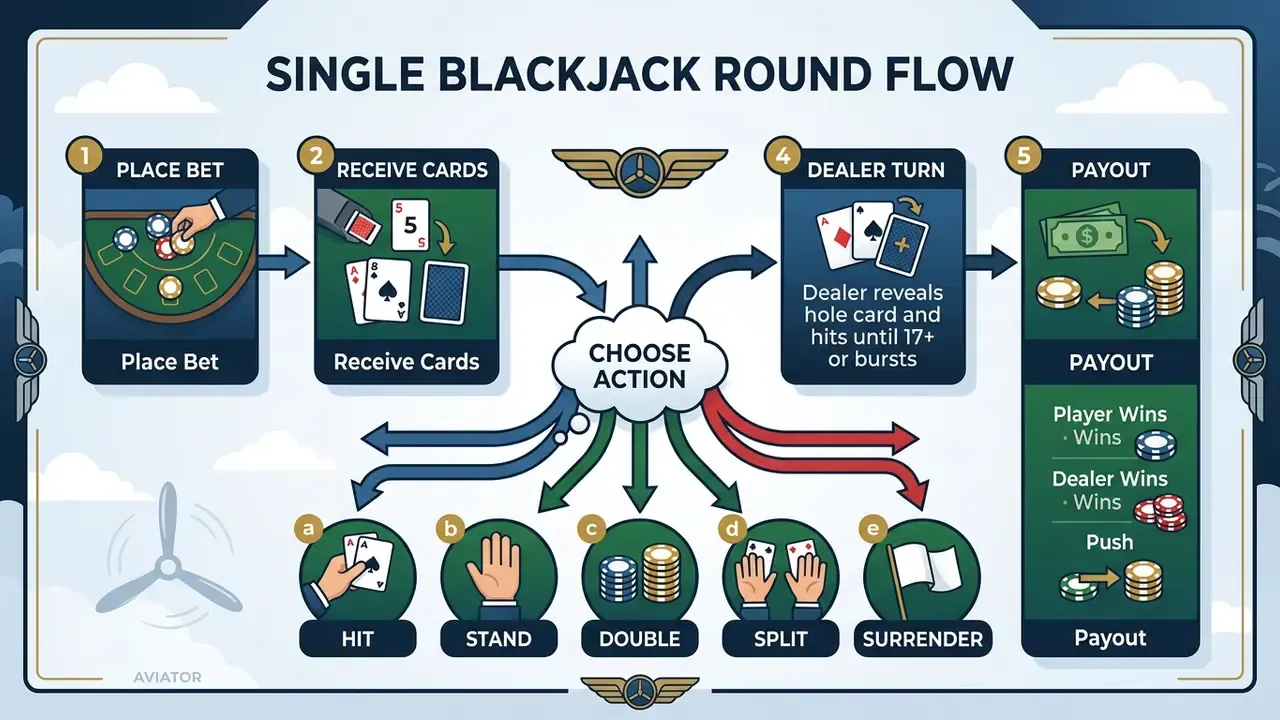
- Place bet in the designated area.
- Receive two cards face-up; dealer receives one face-up, one face-down.
- Choose your action: hit, stand, double, split or surrender.
- Repeat until you stand or bust.
- Dealer reveals hole card and draws according to house rules (typically hits until 17 or higher).
- Payouts are settled: win (1:1), natural blackjack (3:2 or 6:5), push (bet returned) or loss.
How payouts, wins and the house edge work in blackjack
Money outcomes depend heavily on rule variations and blackjack payout logic. The house edge represents the statistical advantage the casino maintains over thousands of rounds. A standard game pays 1:1 for a regular win, while blackjack's highest payout is classically 3:2. Understanding these numbers, and the related concept of RTP, is essential before you place a single chip.
Winning, losing and push outcomes
You win the round if your cards total more than the dealer's hand without exceeding 21, or if the dealer busts. You lose your bet completely if your total crosses 21, regardless of the dealer's subsequent actions. A push outcome occurs when both hands share the exact same valid total, resulting in the return of your initial wager.
Let me put that in rupees. A natural blackjack at a 3:2 table means a ₹100 bet returns ₹250 (your ₹100 plus ₹150 profit), while a standard win returns ₹200. That 50% premium on naturals is precisely why the payout ratio matters so much.
Why blackjack is known for a lower house edge
Blackjack is celebrated for a low house edge because the rules allow players to alter bets mid-hand (double, split) and receive a 3:2 premium on naturals. The expected edge drops to approximately 0.5% when strict basic strategy is applied. Under the most favourable rule configurations, it can fall even further.
"Markov chain analysis shows that with optimal strategy and a 3:2 natural payout, the house advantage drops to approximately 0.3% per hand under favourable rule sets." - Markov Chain Analysis of Blackjack Strategy, Colorado School of Mines (2024).
In terms of RTP (Return to Player), standard 6-deck blackjack with basic strategy offers an RTP of roughly 99.5%. That means for every ₹100 wagered, the expected return is ₹99.50 over the long run. This is one of the highest RTPs in any casino game.
The casino retains an advantage merely because the player must act, and potentially bust, before the dealer plays. Simple, but effective.
6:5 vs 3:2: why it matters for your bankroll. Switching from a 3:2 to a 6:5 blackjack payout increases the house edge by approximately 1.4 percentage points.
"Replacing 3:2 with 6:5 increases the house edge by approximately 1.39 percentage points." - Markov Chain Analysis of Blackjack Strategy, Colorado School of Mines (2024).
Indian players often accept any table rules without checking payouts. Our iGaming team at Casino and Betting India tracked player session data on 6:5 tables versus 3:2 tables across a sample of reviewed platforms. Players on 6:5 tables consistently depleted their bankrolls significantly faster, underlining the importance of always verifying the payout ratio before sitting down. Explore our methodology for reviewing casino platforms for more detail.
Similarly, a rule requiring the dealer to hit on soft 17 (instead of standing) adds several tenths of a percentage point to the casino's advantage, because the dealer more frequently improves weak totals.
Myth-busting blackjack misconceptions:
- "Blackjack is pure luck." False. Basic strategy, first proven mathematically by Edward O. Thorp in Beat the Dealer (1962), reduces the house edge from over 2% to around 0.5%.
- "Insurance helps you win more often." False. Insurance carries a negative expected value of roughly -7.4%.
- "All blackjack tables have the same rules." Also false. Payouts (3:2 vs 6:5), dealer rules (hit vs stand on soft 17), number of decks and surrender availability all vary, even within the same casino.
Blackjack strategy basics for smarter play
Applying basic strategy removes guesswork and establishes a mathematical decision logic for hit/stand, double and split scenarios. Playing blackjack with discipline requires memorizing how your hand total interacts with the dealer's visible card. Think of this section as a practical check before your first session.
"Dynamic programming computes the exact optimal action for every combination of player hand and dealer upcard without approximations." - Optimal Blackjack Strategy Recommender (2024).
Basic strategy was first rigorously proven by Edward O. Thorp using IBM 704 computer simulations at MIT, published in Beat the Dealer (1962). Modern online casinos universally permit players to consult strategy cards or charts during play. They are considered non-electronic memory aids and do not alter the RNG.
Basic strategy decisions for hit or stand
You must always hit when your total is 8 or lower, and stand when holding any hard total of 17 or more. When your total sits between 12 and 16, your decision relies firmly on the dealer card. Stand if the dealer shows a weak 2 through 6, as they carry a high risk of busting. Hit if the dealer shows 7 through an Ace. The dealer is statistically likely to reach 17 or higher in about 74% of those cases.
For soft hands, the general rule is to hit on soft totals below 17 and stand on soft 18, 19 or 20. Straightforward enough, but easy to forget under pressure.
Quick-reference basic strategy chart
Use this simplified chart as a starting-point cheat sheet. "H" = Hit, "S" = Stand, "D" = Double (hit if not allowed), "SP" = Split.
| Your Hand | Dealer 2-6 | Dealer 7-A |
|---|---|---|
| Hard 8 or less | H | H |
| Hard 9 | D | H |
| Hard 10-11 | D | D (hit vs A on 10) |
| Hard 12-16 | S | H |
| Hard 17+ | S | S |
| Soft 13-17 | H (D on soft 15-17 vs 4-6) | H |
| Soft 18 | S (D vs 3-6) | S (H vs 9, 10, A) |
| Soft 19-20 | S | S |
| A-A or 8-8 | SP | SP |
| 10-10 | S | S |
| 5-5 | D | D (H vs A) |
This is a simplified overview. Full basic strategy charts with every combination are available in dedicated blackjack strategy references.
When double and split become useful options
Doubling is a strong option when you hold a 9, 10, or 11 against a weak dealer upcard (2-6). Splitting is mathematically required when you hold a pair of Aces or 8s. Two 8s make a terrible hard 16, statistically the worst hand in the game, but dividing them provides two chances to build strong hands.
"Markov chain analysis confirms that the expected value of splitting eights exceeds that of standing or hitting under most realistic rule configurations." - Markov Chain Analysis of Blackjack Strategy, Colorado School of Mines (2024).
Never split 10s. A 20 is already a dominant position. And never split 5s. Treat a pair of fives as a hard 10 and double down when possible.
Critical rule for split Aces: When you split Aces, most casinos deal only one additional card per hand, and you typically cannot re-split if another Ace appears. An Ace plus a 10-value card after a split counts as 21 but not as a natural blackjack, so the payout is 1:1 rather than 3:2. That distinction costs real money over time.
Common blackjack mistakes to avoid
The most detrimental mistake is copying the dealer's logic, hitting until 17 regardless of context, instead of following basic strategy. This ignores the player's ability to double, split or surrender and can increase the house edge by 5% or more.
Other frequent errors:
- Overusing the insurance bet. A consistent money-loser for non-card-counters.
- Ignoring table rules. Playing at a 6:5 table when a 3:2 table is available next door.
- Over-betting relative to your bankroll. Research shows that betting above sustainable bankroll levels sharply increases the probability of ruin, even when the house edge is small.
"Bets exceeding a sustainable bankroll threshold dramatically increase the probability of ruin even with a small house edge." - Optimal Blackjack Betting Strategies Through Dynamic Programming (2025).
Checklist: Before-you-play blackjack essentials
- Confirm the table pays 3:2 (not 6:5) for a natural blackjack.
- Check whether the dealer stands or hits on soft 17.
- Know all card values and soft/hard hand differences.
- Review the basic strategy chart for your hand range.
- Set a firm loss limit and session time before placing any bet.
- Verify that split, double and surrender options are available.
- Avoid random side bets unless you understand the odds.
- Watch the dealer's upcard before every decision.
Popular blackjack side bets
Side bets are optional wagers placed alongside your main bet before cards are dealt. They offer higher payouts but come with a significantly higher house edge, often 3-10% or more. Understanding them helps you decide whether the entertainment value is worth the extra cost.
| Side Bet | How It Works | Typical Payout |
|---|---|---|
| Perfect Pairs | Your first two cards form a pair (mixed, coloured or perfect) | Up to 25:1 (perfect pair) |
| 21+3 / Rummy | Your two cards + the dealer's upcard form a poker hand (flush, straight, three-of-a-kind) | Up to 100:1; standard suited trips 9:1 |
| Super 7 | Your first card(s) are 7s; consecutive 7s multiply the payout | Up to 5,000:1 (three suited 7s) |
| Insurance | Dealer's upcard is an Ace; you bet the hole card is a 10 | 2:1 |
Side bets appear in games like Perfect Pairs Blackjack, Super 7 Blackjack and most live dealer tables. They do not change the rules of the main hand, but they significantly increase variance. If you are focused on maximizing long-term return, the main hand with basic strategy remains the optimal path. Side bets are entertainment, not strategy.
Blackjack online vs live blackjack: what to choose
Choosing between online blackjack and live blackjack formats comes down to game speed, interface preferences, and mobile-first convenience. Both formats use rigorous algorithms or physical cards to determine outcomes, but the gameplay differences affect your entertainment value and session limits.
"Behavioural data show that participation in live casino games correlates more strongly with markers of gambling-related harm than participation in software-based tables." - Behavioral Markers of Harm and Product Risk in Online Gambling, Delfabbro et al. (2023).
That finding deserves a pause. It does not mean live blackjack is inherently dangerous, but it does suggest that the immersive format can make it harder to step away.

Online blackjack with software tables
Online blackjack relies on software tables powered by a Random Number Generator (RNG) certified by independent auditors such as eCOGRA. Deals are instant. Because there is no human dealer, the pace is rapid, often 2-3 hands per minute. This format lacks a timer, making it a solid option for beginners who want to reference a strategy guide without feeling rushed.
The high speed of RNG tables means more hands per hour, which amplifies the cumulative effect of the house edge on your bankroll over a session. Always set a firm session time and loss limit.
Free play / demo mode: Nearly all RNG blackjack games offer a free demo version. This lets you practise basic strategy, learn the interface and test different variations, all without risking any real money. If you are new to blackjack, starting with a demo is the single best step you can take. No deposit required. No pressure.
Live blackjack with a real dealer
Live blackjack features a real human dealer streamed in HD or 4K from a studio directly to your device. This format provides physical realism and eliminates RNG algorithms, relying on a real card shoe (typically 6-8 decks) instead. You must act within a strict 7 to 15-second timer, which demands complete focus and swift strategy recall.
Hand signals in live streams: While you click buttons rather than physically gesture, understanding hand signals is helpful if you ever play in a land-based casino or want to follow the dealer's actions on-screen more intuitively. Tap the table to hit, wave horizontally to stand.
Live dealer lobbies also frequently offer side bets such as Perfect Pairs, 21+3 and Back Bets (1:1), which are placed before the deal begins.
Disclaimer: Gambling involves financial risk. Use responsible gambling tools, such as deposit limits, session timers and self-exclusion options, offered by licensed platforms. If you feel gambling is affecting your life, seek help from a qualified professional.
How to choose a blackjack casino or game variation
Evaluating a blackjack casino requires checking table rules, betting limits, and local payment methods available in India. Blackjack games vary vastly. You need to review the game differences regarding payout structures before initiating an INR transaction or performing mandatory KYC (Know Your Customer) verification.
What to compare before you play blackjack online
Before you claim an offer or start betting, verify table limits to ensure they align with your bankroll. Assess whether the dealer is forced to stand on soft 17, and check if the casino limits payouts to 6:5.
"Requiring the dealer to hit on soft 17 increases the house edge by several tenths of a percentage point, because the dealer more frequently improves weak totals." - Markov Chain Analysis of Blackjack Strategy, Colorado School of Mines (2024).
For Indian users, payment friction matters. Compare the speed of UPI and NetBanking options offered by the platform. Check the number of decks (single-deck games can be appealing but are more likely to carry a 6:5 payout). Verify the availability of surrender and double-after-split options.
How bonuses work in blackjack: Casino bonuses (welcome offers, deposit matches) typically come with wagering requirements. For blackjack, the contribution rate toward clearing those requirements is usually only 5-10%, compared to 100% for slots. Let me put that in perspective. A ₹10,000 bonus with 30x wagering and 10% blackjack contribution requires ₹30,00,000 in blackjack bets to unlock. That makes the bonus far less valuable than it appears on the surface. Always read the terms.
During platform reviews at Casino and Betting India, we identified users struggling with blocked withdrawals on specific table games. We audited the withdrawal policies and flagged casinos using hidden wagering restrictions on table games. Players who used our checklist avoided restrictive platforms entirely. Explore our comparison of casino platforms for the latest findings.
Popular blackjack game formats and rule variations
Modern platforms provide different blackjack games that alter traditional rules. Understanding these variations is key to managing your risk.
| Variation | Key Rule Difference | Effect on Strategy |
|---|---|---|
| Classic (6-deck, 3:2) | Standard rules; dealer stands on soft 17 | Baseline: lowest house edge with basic strategy (~0.5%) |
| Spanish 21 | All 10-spot cards removed (48-card decks); late surrender and bonus payouts for multi-card 21 | Drastically changes strategy; house edge can be ~0.4% with optimal play but requires different charts |
| Free Bet Blackjack | Complimentary doubles and splits on certain hands; dealer push on 22 | Push-22 rule increases house edge; free bets offset some of that |
| Blackjack Switch | Two hands dealt; players may swap second cards between hands | Swapping reduces player disadvantage but natural blackjack pays 1:1, not 3:2 |
| Super Fun 21 | Pays 6:5 on natural blackjack; various bonus payouts for specific hands | Lower return than classic; payout structure significantly hurts long-term EV |
These rule changes deeply affect your risk exposure. Regulatory documents confirm that Super Fun 21's 6:5 natural payout substantially reduces the player's expected return compared to classic 3:2 rules. If you are unsure which variation to pick, classic 6-deck 3:2 is almost always the safest starting point.
References and casino rules for verifying mechanics:
- Evolution Gaming Live Blackjack Methodology - evolution.com
- eCOGRA Technical Standards for RNG Games - ecogra.org
- Wizard of Odds Blackjack Hand Types Analysis - wizardofodds.com
- Nevada Gaming Control Board, Blackjack Game Standards - gaming.nv.gov
Is online blackjack legal in India?
India's gambling laws are complex and vary by state. The central Public Gambling Act of 1867 prohibits operating physical gambling houses but does not explicitly address online gambling. Individual states set their own rules:
- States where online gambling is broadly restricted or banned: Telangana, Andhra Pradesh, Tamil Nadu (though legal challenges continue), and some others have enacted specific laws against online real-money games.
- States with more permissive frameworks: Goa, Sikkim and Meghalaya have licensing regimes that allow certain forms of online gambling.
- Most other states fall into a grey area where offshore casino platforms are not explicitly banned but not regulated either.
Practical steps for Indian players:
- Complete KYC verification before depositing. Licensed platforms require identity and address proof. Failure to complete KYC can lead to blocked withdrawals.
- Use only platforms licensed by recognised international regulators (e.g., Malta Gaming Authority, UK Gambling Commission, Curacao eGaming).
- Declare winnings for tax purposes. Under Indian tax law, gambling winnings are taxable at 30% (plus cess) under Section 115BB of the Income Tax Act.
Disclaimer: This section is for informational purposes only and does not constitute legal advice. Laws change frequently. Consult a qualified legal professional in your state before engaging in online gambling.
FAQ about playing blackjack online
Respuestas renderizadas en formato acorde al diseГ±o exportado: tarjetas oscuras, acento dorado y despliegue compacto.
1 Can blackjack rules change from one table or casino to another?
Can blackjack rules change from one table or casino to another?
Yes. Table-specific rules matter because different software providers (Evolution, Playtech, Pragmatic Play) build distinct mechanics. One virtual table might permit late surrender and a 3:2 payout, while the adjacent table enforces a 6:5 payout and restricts splitting. Players must verify these parameters directly within the game's help menu or rules tab.
2 Is live blackjack better for beginners than standard online blackjack?
Is live blackjack better for beginners than standard online blackjack?
Standard software (RNG) blackjack is generally superior for absolute beginners. The automated format lacks a timer, allowing you to review basic strategy charts calmly and even use the free demo mode to practise risk-free. Live blackjack introduces a betting clock and social synchronisation, which often causes unnecessary pressure when you are still memorising card values.
3 What should you check before your first blackjack game?
What should you check before your first blackjack game?
Check the bet limits, verify the presence of a 3:2 payout, confirm the number of decks and whether options like split, double and surrender are available. Ensure the platform holds a valid licence and has a clear KYC process. Set your loss limit securely before the first hand. Treat casino play strictly as paid entertainment, deciding on a firm walk-away point if the odds do not fall in your favour.
4 Can I try blackjack for free before playing with real money?
Can I try blackjack for free before playing with real money?
Yes. Almost all RNG blackjack games offer a free-play or demo mode. This is the ideal environment for practising basic strategy, testing different game variations and getting comfortable with the interface. Live dealer games, however, typically require a real-money bet to participate. If you are not sure whether blackjack suits you, demo play costs nothing and teaches you plenty.
5 What is a good blackjack RTP and how does it compare to other games?
What is a good blackjack RTP and how does it compare to other games?
A standard 6-deck blackjack game with basic strategy offers an RTP of roughly 99.4-99.6%, depending on the specific rule set. This is significantly higher than slots (typically 92-97%) or roulette (94.7-97.3%). The exact RTP depends on rules like 3:2 vs 6:5 payout, dealer stand/hit on soft 17 and the number of decks. In practical terms, blackjack gives you more playing time per rupee wagered than almost any other casino game, provided you follow basic strategy.
Disclaimer: Gambling involves financial risk. Information in this guide is general in nature and does not replace professional advice. Play responsibly.
Beginner concerns around online blackjack often focus on rule fairness, game choice, and account access. Here are quick answers resolving the confusion surrounding these topics, helping you evaluate platforms before risking real funds.