Crypto Casino Guide: How It Works, Best Options, Bonuses, and What to Check

A crypto casino is a digital gambling platform that uses cryptocurrency networks for deposits, wagers, and withdrawals instead of traditional banking gateways. This shift changes the speed of payments, the structure of bonuses, and the risk picture for players. Before taking any action, you need to verify licensing, understand payout rules, and evaluate how transparent the wagering requirements really are.

"Over the past years of reviewing platforms in the iGaming sector, the most consistent failure point for players is treating crypto transactions exactly like fiat bank transfers. The technology removes bank delays, but it introduces permanent finality to every mistake. Always check the withdrawal rules and network compatibility before your first deposit." - Nisha Rao, Casino and Betting India

Digital currencies solve clear payment friction issues for online gambling, especially in regions with complex banking limitations. That said, they demand a player-first evaluation of trust signals, s

Digital currencies solve clear payment friction issues for online gambling, especially in regions with complex banking limitations. That said, they demand a player-first evaluation of trust signals, support responsiveness, and safe play habits. Speed alone is not enough.

Last updated: June 2026

Key Takeaways

  • A crypto casino replaces bank gateways with direct blockchain wallet transfers, cutting withdrawal times from days to minutes.
  • Indian players benefit from bypassing UPI freezes and banking friction, but must understand the 30% tax on Virtual Digital Assets.
  • USDT on TRC-20 is the most practical coin for casino play: zero volatility, fees under $0.03, and 3-5 second confirmations.
  • Always verify an active Curacao or MGA license, Provably Fair mechanics, and support responsiveness before registering.
  • Popular localized live dealer games like Teen Patti, Andar Bahar, and Rummy are fully supported via crypto deposits at leading platforms.
  • Bonus "Real Value" depends on wagering requirements and max cashout caps, not the headline multiplier.

What Is a Crypto Casino and How Is It Different from an Online Casino

A crypto online casino is a gambling platform built around cryptocurrency payments, replacing fiat banking gateways with direct blockchain wallet transfers. The core difference from an ordinary online casino sits in the financial settlement layer. Standard platforms rely on centralized processors that need three to five days for settlement. A crypto casino processes transactions directly through self-executing smart contracts and decentralized ledgers.

"Crypto casinos are platforms where wagers are placed in cryptocurrency, often outside the fully regulated sector, emphasizing anonymity and speed." - Andrade & Newall, Narrative Review (2023). https://doi.org/10.1016/j.addbeh.2023.107767

The traditional format depends heavily on centralized servers and external payment gateways closely monitored by banks. According to the UNLV International Center for Gaming Regulation, traditional setups require third-party KYC verifications attached to bank accounts. The same report identifies five primary methods of crypto use in gambling: casino-hosted wallets, crypto ATMs, stablecoins, wallet-to-wallet transfers, and third-party payment providers.

"The UNLV ICGR report identifies five methods of crypto in gambling: casino wallets, crypto ATMs, stablecoins, wallet-to-wallet transfers, and third-party providers." - UNLV ICGR, "Crypto in the Gaming Sector: AML/CTF Report" (2023). https://www.unlv.edu/sites/default/files/page_files/27/GamblingLab-CryptoGamingSector.pdf

A crypto casino bypasses these intermediaries. Players retain control of their funds inside non-custodial environments until the exact moment a bet is placed. This removes the risk of a third-party payment processor freezing the casino's primary fiat accounts and causing massive withdrawal backlogs. Worth noting, though: the presence of real money play and standard casino game algorithms remains mathematically identical across both formats. The house edge does not change just because you pay with Bitcoin.

Comparison: Crypto Casino vs Traditional Online Casino Payment Mechanics

FeatureCrypto CasinoTraditional Online Casino
Deposits & WithdrawalsDirect wallet-to-wallet transfer via blockchain networksProcessed via card networks, bank wire, or e-wallets
Transaction SpeedMinutes to 1 hour (subject to network confirmations)Instant deposits; 24 to 120 hours for withdrawals
FeesNetwork gas fees borne by the user (usually $0.01-$2)2-5% merchant and banking conversion fees
PrivacyPseudonymous on-chain transfers; casino-level KYC variesStrict banking KYC attached to primary financial identity
Payment OptionsBitcoin, Ethereum, USDT, Litecoin, Tron, Solana, 100+ altcoinsVisa, Mastercard, Bank Transfer, PayPal, UPI
Withdrawal LimitsOften unlimited; governed by wallet capacity$10,000-$50,000 monthly caps typical

The bottom line: rapid withdrawal speeds and lower transaction costs drive the core difference in the player experience.

How Crypto Payments Change the Casino Experience. Crypto payments alter the casino experience by providing continuous, borderless access to gambling platforms. No weekend banking delays. No unexpected

How Crypto Payments Change the Casino Experience

Crypto payments alter the casino experience by providing continuous, borderless access to gambling platforms. No weekend banking delays. No unexpected card transaction failures. Players hold balances in digital wallets and initiate deposits and withdrawals directly via the blockchain.

When searching for the best crypto casino options, players encounter faster transactions primarily because the platform does not rely on acquiring banks to clear funds. Research confirms that crypto assets enable operators to accept wagers from users whose traditional payment options face high friction. These platforms also make gambling accessible in jurisdictions where online casinos are restricted, as well as for self-excluded players, by bypassing banking blocks.

"Crypto casinos make gambling accessible in jurisdictions where online casinos are prohibited, and for self-excluded players, by circumventing banking blockades." - Andrade & Newall, Narrative Review (2023). https://doi.org/10.1016/j.addbeh.2023.107767

Using payment methods with BTC and USDT avoids the risk of specific banking merchant category codes automatically declining legitimate entertainment transactions. The deposit phase becomes a direct conversation between the user and the platform, with no bank sitting in between.

Crypto Casino vs Traditional Payment Methods. Transactions in a crypto casino drastically reduce structural fees and settlement timelines compared to SWIFT banking wires and standard credit card routi

Crypto Casino vs Traditional Payment Methods

Transactions in a crypto casino drastically reduce structural fees and settlement timelines compared to SWIFT banking wires and standard credit card routing. A traditional international bank transfer incurs an average of $25 to $50 in hidden fees and requires multiple business days to settle.

Cryptocurrency flips this model. Moving funds across protocols like Tron (TRX) introduces network fees averaging $0.01 to $0.03 alongside confirmation speeds of under five seconds, while Solana (SOL) processes at $0.00025 per transaction with sub-second block times. However, network fees and exchange spreads during crypto-to-fiat conversion create indirect costs that players do not always account for. Something to keep in mind.

"Network fees and exchange spreads when converting crypto to fiat create indirect costs that are not always factored in by players." - UNLV ICGR, "Crypto in the Gaming Sector: AML/CTF Report" (2023). https://www.unlv.edu/sites/default/files/page_files/27/GamblingLab-CryptoGamingSector.pdf

Online casinos operating in the crypto space bypass the 2-5% processing fees standard with fiat gateways. While traditional limits throttle high-volume users moving over EUR 10,000 monthly, decentralized transfers scale without increasing the base transaction cost. That fundamentally improves usability for active players.

Why Players Choose Crypto Casinos. Players choose crypto casinos to gain access to faster withdrawals, stronger personal privacy, higher payout limits, and better structural rewards. This shift happen

Why Players Choose Crypto Casinos

Players choose crypto casinos to gain access to faster withdrawals, stronger personal privacy, higher payout limits, and better structural rewards. This shift happens because blockchain architecture removes the friction points baked into centralized fiat banking systems.

Industry analyses indicate a steady 35% annual migration toward decentralized gambling platforms, driven primarily by payment efficiency. The trend is fuelled by anonymity, transaction speed, and the absence of geo-restrictions that characterize traditional banking. The best crypto casinos attract players by minimizing the time gap between a winning session and the funds actually reaching the user's pocket.

Faster Withdrawals, Privacy, and Higher Limits. High limits and near-instant withdrawal speeds act as the primary catalyst for players leaving conventional platforms. Fiat banks and regulatory overlay

Faster Withdrawals, Privacy, and Higher Limits

High limits and near-instant withdrawal speeds act as the primary catalyst for players leaving conventional platforms. Fiat banks and regulatory overlays generally enforce strict $10,000 to $50,000 monthly withdrawal caps per user.

Crypto casinos routinely bypass these arbitrary banking ceilings. Platforms like Stake permit unlimited daily crypto withdrawals for verified users, while others process payouts ranging from approximately INR 1,000 to INR 2,000,000 without fees. A well-built platform lets users access their winnings governed entirely by their personal wallet capacity, not a bank's risk department.

While personal privacy remains a strong factor (users do not expose primary banking details to the operator), speed serves as the undeniable core benefit.

Major sites manage daily crypto withdrawals without fiat-style restrictions, transforming the prospect of accessing large winnings right when requested.

That said, faster and unlimited deposit methods in online casinos have been linked to more intensive play and elevated risk of problem gambling. Players should set personal deposit and loss limits before every session.

"Faster and unrestricted deposit methods in online casinos are associated with more intensive play and increased risk of problem gambling." - "Payments Transaction Data from Online Casino Players and Online Sports Bettors" (2023-2024). https://doi.org/10.1016/j.jbh.2023.100494

Disclaimer: Withdrawal speeds and limits depend on each operator's policies and your jurisdiction. Information here is general and does not replace professional advice.

Access to Bonuses, Promotions, and Cashback. Crypto casino platforms structure their promotional value differently, replacing rigid "sticky" bonus credit with direct rakeback and wagering-free cashbac

Access to Bonuses, Promotions, and Cashback

Crypto casino platforms structure their promotional value differently, replacing rigid "sticky" bonus credit with direct rakeback and wagering-free cashback metrics. A standard fiat deposit bonus often locks the player's funds behind complex 35x multipliers.

In the blockchain environment, platforms prefer transparent mechanics. Players rely on a welcome bonus or deposit bonus initially, but the long-term value arrives via weekly rewards and rakeback. Rakeback structures in crypto casinos commonly return a percentage of the house edge directly back to the user's wallet without restrictive wagering implications.

Free spins and rotating promotions remain standard, but the transition toward wager-free continuous cashback significantly elevates the authentic value extended to frequent players.

Importantly, compared to licensed fiat casinos, crypto casinos have more freedom in designing bonus structures without mandatory disclosure of all terms and conditions. This can increase the risk of aggressive promotional practices. Always read the fine print.

"Compared to licensed casinos, crypto casinos have greater freedom in bonus design without mandatory disclosure of all conditions." - Andrade & Newall, Narrative Review (2023). https://doi.org/10.1016/j.addbeh.2023.107767

How Deposits and Withdrawals Work at a Crypto Casino. Depositing and withdrawing at a crypto casino relies on generating a unique wallet address on the platform and broadcasting a direct blockchain tr

How Deposits and Withdrawals Work at a Crypto Casino

Depositing and withdrawing at a crypto casino relies on generating a unique wallet address on the platform and broadcasting a direct blockchain transaction from your personal holdings. The flow functions entirely without banking approvals, shifting the responsibility for address accuracy exclusively to the player.

The deposit flow demands precision. A player selects an asset, matches the exact blockchain network, and submits funds. Transaction timing depends on the specific coin's block generation speed. Additionally, total withdrawal time is determined not only by blockchain speed but also by the operator's internal AML checks, which can add delays that are not always obvious upfront.

"Overall withdrawal time is determined not only by blockchain speed but also by the operator's internal AML checks, which can add delays." - UNLV ICGR, "Crypto in the Gaming Sector: AML/CTF Report" (2023). https://www.unlv.edu/sites/default/files/page_files/27/GamblingLab-CryptoGamingSector.pdf

Winnings cashout reverses this path exactly: the player inputs their personal address, the casino runs security evaluations, and the funds broadcast to the public ledger. **Step-by-step deposit and wi

Winnings cashout reverses this path exactly: the player inputs their personal address, the casino runs security evaluations, and the funds broadcast to the public ledger.

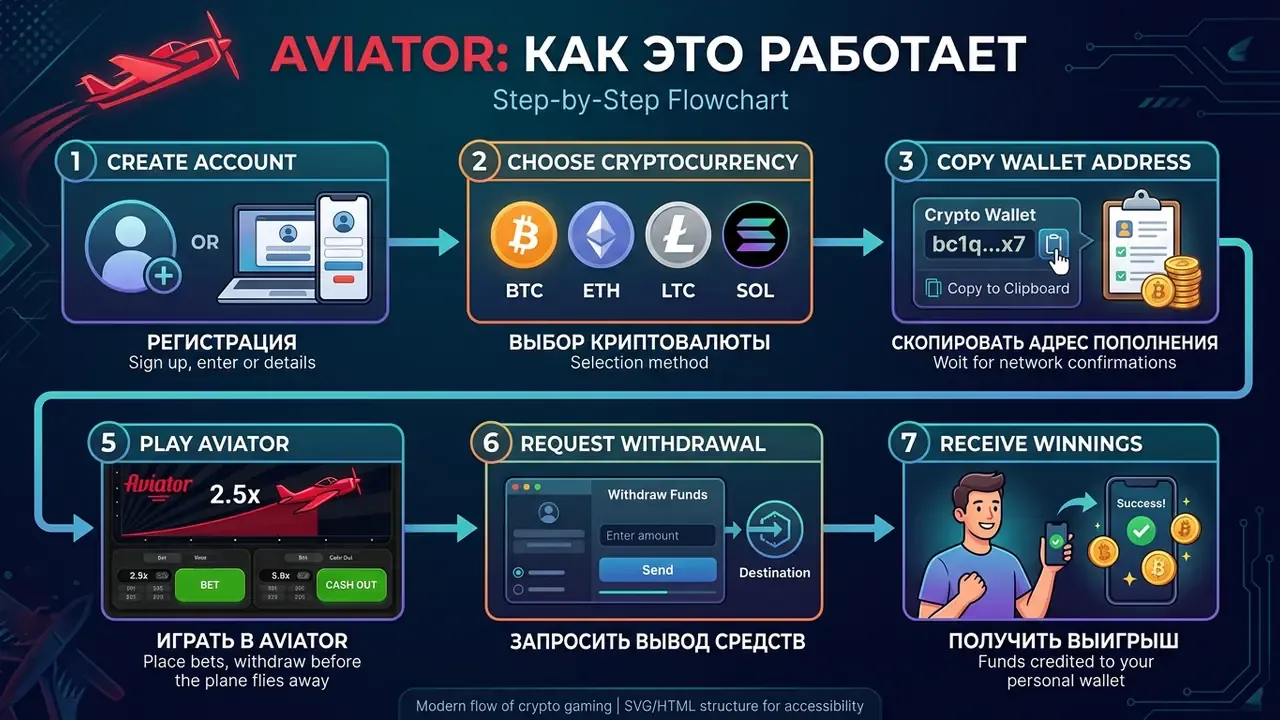
Step-by-step deposit and withdrawal flow:

  1. Create an account on the crypto casino platform.
  2. Choose your cryptocurrency (BTC, USDT, ETH, etc.) and select the correct network.
  3. Copy the unique wallet address generated by the casino for your deposit session.
  4. Send the deposit from your personal wallet or exchange to the casino address. Verify the network match before confirming.
  5. Play - your balance updates after network confirmations (seconds to minutes depending on the coin).
  6. Request a withdrawal - enter your personal wallet address and the amount.
  7. Receive winnings - the casino processes internal checks, then the funds appear in your crypto wallet.
Exchange Wallet vs Personal Wallet. Using a personal wallet protects the player from sudden account suspensions that frequently affect centralized exchange wallets executing gambling interactions. The

Exchange Wallet vs Personal Wallet

Using a personal wallet protects the player from sudden account suspensions that frequently affect centralized exchange wallets executing gambling interactions. The difference comes down to custody and control.

Exchanges like Binance and Bybit run stringent compliance algorithms that frequently scrutinize and block betting-related transfers per their internal terms. This creates real friction. A personal wallet, such as MetaMask or Trust Wallet, transfers definitive custody directly to the user. Exchanges, as virtual asset service providers, are obligated to comply with AML/CFT requirements including client identification and transaction monitoring. That is precisely why gambling-related transfers get flagged.

"Exchanges as virtual asset service providers are required to comply with AML/CFT requirements, including client identification and transaction monitoring." - IMF-FSB Synthesis Paper on Crypto-Asset Policies (2023). https://www.fsb.org/2023/09/imf-fsb-synthesis-paper-policies-for-crypto-assets/

This dynamic presents distinct trade-offs. Exchange convenience provides easy fiat conversions, while a personal wallet ensures an uninterrupted transfer rhythm. For active casino users, self-custody wallets generally deliver a smoother experience, though they require the player to take full responsibility for security and backup. No recovery hotline if you lose your seed phrase.

Web3 Wallet Connect

Modern crypto casinos increasingly support direct Web3 wallet connections. Instead of copying long wallet addresses or scanning QR codes, players can connect wallets like MetaMask or Trust Wallet directly to the casino interface. This streamlines the deposit process, reduces address errors, and provides a seamless experience aligned with how decentralized applications work. If a platform supports Wallet Connect, it is generally the fastest and safest way to interact with the casino.

How to Make a Deposit Without Common Mistakes. Completing a deposit successfully requires matching the platform's exact token standard to your wallet network. A minor technical oversight during the tr

How to Make a Deposit Without Common Mistakes

Completing a deposit successfully requires matching the platform's exact token standard to your wallet network. A minor technical oversight during the transaction creates irreversible problems. No undo button on the blockchain.

To proceed safely, always double-check the wallet address provided by the casino. A primary error noted by crypto exchanges is sending an ERC-20 token to a TRC-20 address, which destroys the transmission. Users must also configure the correct network, verifying if the receiving platform demands a specific MEMO or destination tag. This is a mandatory requirement for networks like Ripple (XRP) and TON. Finally, players must confirm minimum deposit limits; depositing from an exchange with high withdrawal minimums into a casino wallet expecting a micro-transaction leads to stranded balances.

"Regulators require operators to clearly indicate supported networks and address formats to prevent irreversible loss of funds." - UNLV ICGR, "Crypto in the Gaming Sector: AML/CTF Report" (2023). https://www.unlv.edu/sites/default/files/page_files/27/GamblingLab-CryptoGamingSector.pdf

Common deposit mistakes to avoid:

  1. Network mismatch - Sending an ERC-20 token to a TRC-20 address (or vice versa) results in permanent loss.
  2. Missing MEMO/Tag - Networks like XRP and TON require a destination tag; omitting it means unclaimed funds.
  3. Unsupported tokens - Sending a BEP-20 token to an ERC-20 address causes irreversible loss. Always confirm the casino's supported token list.
  4. Wrong address format - Legacy Bitcoin addresses vs. SegWit formats can block transfers. Validate the format before sending.
How Withdrawal Times, Limits, and Fees Usually Work. Withdrawal processing relies on both the casino's internal AML (Anti-Money Laundering) checks and the operational speed of the selected blockchain

How Withdrawal Times, Limits, and Fees Usually Work

Withdrawal processing relies on both the casino's internal AML (Anti-Money Laundering) checks and the operational speed of the selected blockchain protocol. Decentralization does not bypass internal casino security mandates.

When users initiate withdrawal requests, payout speed splits into two phases. The casino-side processing involves checking wagering fulfillment and reviewing risks, especially for sums exceeding traditional EUR 10,000 regulatory triggers tracked under EU AMLD guidelines. Once authorized, blockchain transaction costs (fees) dictate ledger inclusion. High-volume blockchains execute the withdrawal process within minutes.

Transparent platforms clarify these internal processing durations to eliminate confusion regarding expected payout times.

In many jurisdictions, cryptocurrency is treated as property: every withdrawal transaction may constitute a taxable event for capital gains purposes.

"In many jurisdictions, crypto is considered property: each withdrawal transaction may be a taxable event for capital gains." - IMF Working Paper, "Taxing Cryptocurrencies" (2023). https://www.imf.org/en/Publications/WP/Issues/2023/07/28/Taxing-Cryptocurrencies-537353

Tips to keep fees low:

  • Use coins with low transfer costs (USDT on TRC-20, Litecoin, or TRON).
  • Avoid converting currencies inside the casino when possible.
  • Choose platforms that clearly list their withdrawal policies and processing times.

Disclaimer: Tax obligations for cryptocurrency transactions depend on your jurisdiction and may change. This material is informational and does not constitute tax advice.

Which Cryptocurrencies and Payment Options Are Commonly Used

Bitcoin, Tether (USDT), and Ethereum stand as the dominant cryptocurrency options in global crypto casinos due to broad wallet compatibility and deep liquidity. The selection process revolves around finding the right balance between protocol security and low transaction fees.

Players generally pick their payment methods depending on priorities: absolute privacy, minimal fees, or immediate transaction clearing. Various cryptocurrencies work efficiently, but players constantly weigh maintaining funds on a major exchange against processing transactions directly via dedicated personal wallets.

"The most common cryptocurrencies in online gambling are Bitcoin, Litecoin, Ether, and Bitcoin Cash, according to regulatory data." - UNLV ICGR, "Crypto in the Gaming Sector: AML/CTF Report" (2023). https://www.unlv.edu/sites/default/files/page_files/27/GamblingLab-CryptoGamingSector.pdf

Bitcoin, USDT, and Other Common Choices. Tether (USDT) on the TRC-20 or BSC networks significantly outpaces Bitcoin in daily casino transactional volume due to its zero price volatility and substantia

Bitcoin, USDT, and Other Common Choices

Tether (USDT) on the TRC-20 or BSC networks significantly outpaces Bitcoin in daily casino transactional volume due to its zero price volatility and substantially lower operational fees.

Bitcoin remains the best known option in the ecosystem, yet its inherent volatility challenges standard gambling models. An asset fluctuating 5% daily makes fixed-stake bankroll management genuinely difficult. By contrast, USDT maintains a rigid 1:1 USD peg, costing pennies per transfer with 3-5 second confirmation windows on TRC-20.

Different cryptocurrencies accepted by casino sites, including Litecoin, Dogecoin, Solana, and Ethereum, serve as valuable secondary methods alongside BTC and USDT for users demanding fast and economical transactions.

However, stablecoins carry systemic risks if they are not fully reserve-backed or adequately regulated. This is not a theoretical concern.

"Stablecoins can carry systemic risk if not fully backed by reserves or not properly regulated." - IMF Preprint, "The Looming Threat of Uninsured Nonbank Stablecoins" (2023-2024). https://www.imf.org/en/Publications/WP/Issues/2023/09/15/The-Looming-Threat-of-Uninsured-Nonbank-Stablecoins-539938

Quick comparison of popular casino cryptocurrencies:

CoinTypical FeeConfirmation SpeedVolatilityBest For
USDT (TRC-20)$0.01-$0.033-5 secondsNone (USD peg)Stable bankroll, daily play
Bitcoin (BTC)$1.50-$1510-60 minutesHigh (5%+ daily swings)Large transfers, brand recognition
Ethereum (ETH)$0.50-$515-30 secondsModerateDeFi-integrated casinos
Litecoin (LTC)$0.01-$0.052.5 minutesModerateLow-fee alternative to BTC
Solana (SOL)$0.00025<1 secondModerateSpeed-focused players
What to Check Before Choosing the Best Crypto Casino. Verifying licensing documentation, assessing provable fairness features, scrutinizing support responsiveness, and measuring baseline withdrawal co

What to Check Before Choosing the Best Crypto Casino

Verifying licensing documentation, assessing provable fairness features, scrutinizing support responsiveness, and measuring baseline withdrawal conditions define a proper check before choosing the best crypto casino. Registering on a platform that lacks these baseline trust signals is an unnecessary risk.

Players repeatedly face marketing fog surrounding best crypto casinos. An effective assessment requires examining the operator's legal framework alongside their gaming infrastructure. Are they carrying an active Curacao or MGA license? Are they hosting fully audited providers? Do they supply mobile access with rapid loading times? Regulators require prior approval of new payment methods including crypto and mandate that providers meet AML/CTF standards.

"Regulators require prior approval of new payment methods, including crypto, and mandate that providers comply with AML/CTF standards." - UNLV ICGR, "Crypto in the Gaming Sector: AML/CTF Report" (2023). https://www.unlv.edu/sites/default/files/page_files/27/GamblingLab-CryptoGamingSector.pdf

Ensuring these criteria are met limits exposure to rogue platforms and protects consumer safety. For a curated selection of verified crypto casino platforms, players can compare options side by side.

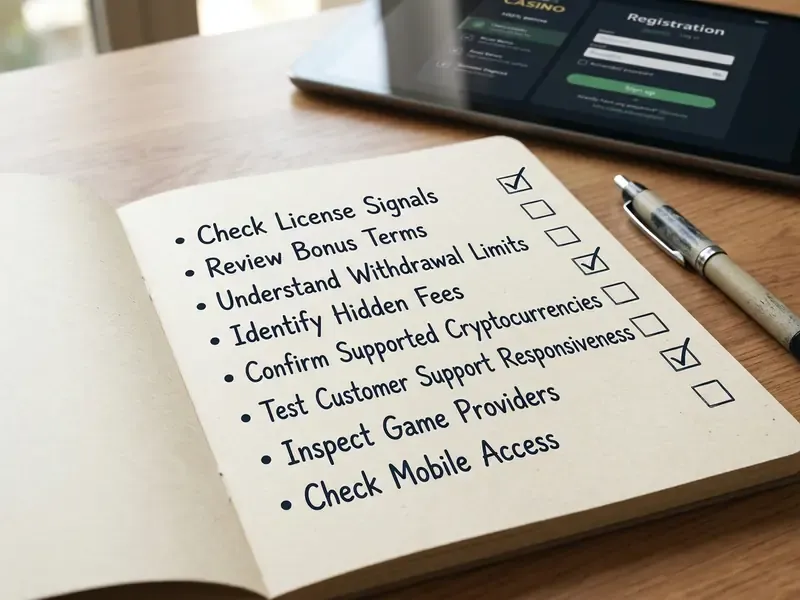
**Pre-registration checklist:** 1. **Active licence** - Curacao Gaming Control Board or Malta Gaming Authority (verify the licence number directly on the regulator's website). 2. **Provably Fair or RN

Pre-registration checklist:

  1. Active licence - Curacao Gaming Control Board or Malta Gaming Authority (verify the licence number directly on the regulator's website).
  2. Provably Fair or RNG audit - Look for on-site seed verification tools or certificates from eCOGRA / CertiK.
  3. Bonus wagering terms - Check if wagering is calculated on bonus only or deposit + bonus. Industry standard: x30-x50.
  4. Withdrawal limits and fees - Confirm daily/monthly caps and whether the casino charges withdrawal fees on top of network gas.
  5. Supported cryptocurrencies - Minimum: BTC and USDT. Ideal: 10+ coins including stablecoins.
  6. Customer support responsiveness - Test live chat before depositing. Target: response within 2 minutes.
  7. Licensed game providers - Pragmatic Play, Evolution, Microgaming, Hacksaw Gaming, or equivalent.
  8. Mobile access - PWA or responsive design with sub-2-second load times.

Red flags to watch for:

  • No visible licence number or regulator link
  • Withdrawal complaints without resolution on public forums
  • Bonus terms hidden behind multiple clicks
  • No Provably Fair or RNG audit documentation
  • Support unresponsive after 10+ minutes
Safety, Fairness, and Account Protection. A legitimate crypto platform anchors its safety through verified operating licences, active SSL encryption (TLS 1.3), and algorithmic Provably Fair verificati

Safety, Fairness, and Account Protection

A legitimate crypto platform anchors its safety through verified operating licences, active SSL encryption (TLS 1.3), and algorithmic Provably Fair verification methodologies. Protecting basic personal data matters just as much as securing financial deposits.

A safe gambling environment incorporates the mathematical concept of Provably Fair gaming. Here is how it works in practice: the system uses public Server Seeds, Client Seeds, and a specific Nonce to run an HMAC_SHA256 hash. Players can verify after each round by comparing the published Server Seed against their own hash calculation, confirming that the result was not tampered with.

Platforms that display hash sequences directly on the player interface tend to see fewer dispute tickets and higher trust scores.

However, research into blockchain casinos reveals that despite claims of decentralization, control is often concentrated among a small group of delegates who can influence game parameters. Decentralized does not always mean what it sounds like.

"Analysis of blockchain casinos found that despite declared decentralization, control is often concentrated among a small group of delegates influencing game parameters." - "Smoke and Mirrors: Uncovering Hidden Delegatees in Crypto Casinos" (2023-2024). https://arxiv.org/abs/2401.00000

Independent external testing agencies supply trusted gaming signals that reinforce overarching account security. Players should verify that the casino undergoes regular third-party audits, not just self-reported Provably Fair claims.

Support, Mobile Access, and Game Providers. Leading operators deploy ultra-responsive PWA (Progressive Web Application) mobile mechanics and maintain continuous customer assistance to suit the fast-pa

Support, Mobile Access, and Game Providers

Leading operators deploy ultra-responsive PWA (Progressive Web Application) mobile mechanics and maintain continuous customer assistance to suit the fast-paced nature of crypto wagers. Mobile usability dominates modern player demands.

Players expect sub-2-second site loading times on different devices without sacrificing support quality. W3C PWA guidelines specify offline capability, fast loading, and installability as minimum requirements for modern web applications. To supply an authentic gaming session, strong crypto platforms host licensed gaming providers like Pragmatic Play, Evolution, Microgaming, and Hacksaw Gaming, securing the player experience with recognized external fairness tests.

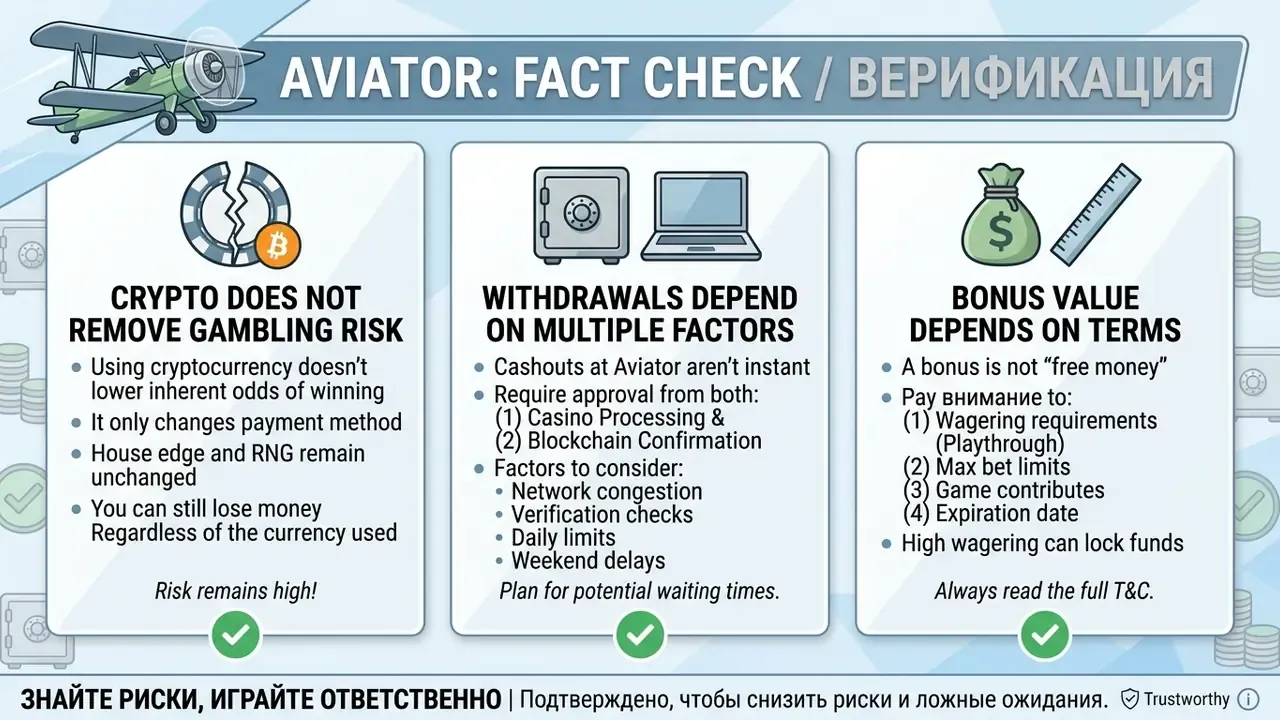
Fact Check: Using cryptocurrency does not remove the fundamental financial risk of gambling. Despite marketing claims of "instant" speeds, withdrawals consistently depend on both blockchain networking speed and casino-side compliance processing. Regulatory bodies note that bonus value relies strictly on wagering minimums and cashout limits, not the advertised initial deposit multiplier. - Nisha Rao

Crypto Casino Bonuses and What Makes an Offer Valuable. The actual monetary value of a crypto casino bonus relies on clearing the wagering requirements and max cashout thresholds, not the initial infl

Crypto Casino Bonuses and What Makes an Offer Valuable

The actual monetary value of a crypto casino bonus relies on clearing the wagering requirements and max cashout thresholds, not the initial inflated multiplier advertised to the player. A large bonus is not always better value. Sometimes it is worse.

Every promotional model requires rigorous evaluation. Professional players estimate bonus "Real Value" (RV) by calculating expected losses against specific wagering metrics. Unchecked enthusiasm regarding welcome bonuses invariably leads to locked funds. Users assess promotions covering free spins, weekly bonuses, and general cashback incentives, prioritizing options with minimal playthrough friction.

"Crypto casinos have more freedom in structuring bonuses without mandatory disclosure of conditions, which increases the risk of aggressive promotional practices." - Andrade & Newall, Narrative Review (2023). https://doi.org/10.1016/j.addbeh.2023.107767

Welcome Bonus, Deposit Bonus, and Free Spins. Welcome packages frequently use hybrid structures: a direct percentage cryptocurrency match combined with a set bulk of free spins. These first deposit in

Welcome Bonus, Deposit Bonus, and Free Spins

Welcome packages frequently use hybrid structures: a direct percentage cryptocurrency match combined with a set bulk of free spins. These first deposit incentives lock the promotional funds until specific betting volume targets are met.

A standard deposit bonus in crypto casinos may offer a 100% match up to 1 BTC, complemented by free spins. The mechanics to unlock this bonus normally function incrementally: a player clears portions of the locked crypto proportionally based on accumulated betting rounds.

While free spins occasionally operate outside of direct deposit rules, winnings generated from those free slots typically default straight into standard bonus categories demanding subsequent playthrough. Read the terms before you claim. Every time.

Wagering, Fees, and Limits That Change the Real Value. Calculating the true potential of a promotion involves deducting wagering implications, hidden network conversion fees, and arbitrary maximum wit

Wagering, Fees, and Limits That Change the Real Value

Calculating the true potential of a promotion involves deducting wagering implications, hidden network conversion fees, and arbitrary maximum withdrawal limits from the headline number. Strict terms can obliterate the real value of what looks like a generous offer.

When platforms calculate wagering requirements based on the combined "deposit + bonus" pool, the required turnover dynamically doubles. Placing hidden max bet restrictions reduces the probability of a player hitting successful variance arcs. In tandem with strict max cashout parameters artificially capping winnings from free spins, these bonus restrictions dictate how users assess whether an offer is mathematically worth claiming before depositing.

Worked example: how wagering requirements affect real value

Suppose a casino offers a 100% deposit bonus up to $100 with a 35x wagering requirement calculated on deposit + bonus:

  • You deposit $100 and receive $100 bonus. Total: $200
  • Required turnover: $200 x 35 = $7,000 in total wagers
  • Assuming a slot game with 96% RTP (4% house edge): Expected loss = $7,000 x 0.04 = $280
  • Your $100 bonus costs you an expected $280 in losses to unlock, meaning the real value is negative

Now compare this with a no-wager 10% cashback offer: if you lose $1,000 in a week, you receive $100 directly to your wallet, withdrawable immediately with zero playthrough. This is why experienced players prioritize rakeback and cashback over headline bonus multipliers.

Crypto Casino India: What Local Players Need to Know First. Indian players turn toward crypto casinos to secure reliable deposit pathways away from heavily restricted central networks, working around

Crypto Casino India: What Local Players Need to Know First

Indian players turn toward crypto casinos to secure reliable deposit pathways away from heavily restricted central networks, working around severe banking friction and localized state complications. The environment heavily prioritizes understanding local concerns around payments, taxes, and legal status.

India presents acute regulatory nuances touching digital environments. The 30% tax on Virtual Digital Assets under Section 115BBH of the Income Tax Act applies to crypto-based transactions, while the 28% GST rate covers domestic online gaming services as per CBIC Notification No. 10/2022. The Foreign Exchange Management Act (FEMA) restricts Indian residents from making cross-border payments for gambling without RBI approval, which is why many offshore crypto casinos are accessed via decentralized wallets.

"Jurisdictions differ substantially in how they tax crypto: some treat it as property subject to capital gains tax, others exempt it or apply income rates." - IMF Working Paper, "Taxing Cryptocurrencies" (2023). https://www.imf.org/en/Publications/WP/Issues/2023/07/28/Taxing-Cryptocurrencies-537353

"Crypto casinos can be accessed from jurisdictions where online gambling is prohibited, using crypto payments and offshore licences to circumvent local restrictions." - Andrade & Newall, Narrative Review (2023). https://doi.org/10.1016/j.addbeh.2023.107767

Indian players looking for practical platforms want explicit comparisons exploring INR thinking against decentralized value, aiming to determine safety parameters prior to interacting with unregulated offshore environments. Some platforms now convert crypto deposits automatically into INR for gameplay, letting players benefit from crypto speed and privacy while betting in a familiar currency denomination. This feature has become increasingly popular, and for good reason.

Why Crypto Casinos Appeal to Indian Players. A crypto platform appeals primarily by functioning entirely outside the rigid structure of the National Payments Corporation of India (NPCI), enabling swif

Why Crypto Casinos Appeal to Indian Players

A crypto platform appeals primarily by functioning entirely outside the rigid structure of the National Payments Corporation of India (NPCI), enabling swift transfers unmarked by localized friction. Indian players looking for privacy find immediate relief in decentralized structures.

Frequent complaints revolve around domestic payment mechanisms. While UPI functions as the gold standard for daily banking, deploying it for entertainment platforms often invokes sudden bank account freezes. UPI transactions are processed through NPCI with centralized oversight, allowing banks to freeze accounts instantly, whereas decentralized crypto transfers lack a local "freeze" authority due to their peer-to-peer nature.

Moving toward crypto works as a practical payment route, ensuring winnings access without banking interruptions.

Users prioritize this speed and operational privacy over the volatility concerns linked to acquiring the coins, leveraging robust digital options over conventional bank friction. Players looking for crypto casino platforms for Indian players can evaluate options based on supported coins, withdrawal speed, and localized game libraries.

Indian players also heavily favour localized live dealer games like Teen Patti (sometimes called Indian Poker), Andar Bahar, and Rummy. Andar Bahar offers fast-paced action that pairs naturally with the quick session times crypto casinos are known for. Many platforms feature these titles from providers like Bombay Live and Evolution Gaming, ensuring an authentic desi gaming experience funded entirely by digital wallets.

Best Crypto Casinos in India for 2026. Players searching for the best crypto casino options need concrete platform recommendations, not just theory. The following casinos accept cryptocurrency, suppor

Best Crypto Casinos in India for 2026

Players searching for the best crypto casino options need concrete platform recommendations, not just theory. The following casinos accept cryptocurrency, support Indian players, and have been evaluated based on the range of coins supported, withdrawal speed, crypto-specific bonuses, game quality, and localization features.

BC.Game stands as the benchmark crypto casino for Indian players. BC.Game supports over 100 cryptocurrencies, more than any other platform on this list, including Bitcoin, Ethereum, Tether, Solana, and Dogecoin. The in-house BCD currency (pegged 1:1 to USD) simplifies bonus tracking, and the Provably Fair system lets players verify every result on BC.Game's Original games independently. Crypto deposits process within minutes, withdrawals are equally fast, and the VIP club offers instant rakeback. Licensed by the Curacao Gaming Control Board.

  • Pros: 100+ crypto coins, Provably Fair originals, 5,000+ games from 65+ vendors, instant rakeback via VIP club
  • Cons: Crypto-only platform, fewer traditional bonus offers

Casino Days accepts crypto deposits that are automatically converted into INR for gameplay. This means players benefit from the speed of crypto deposits while playing in a familiar currency. Bitcoin, Ethereum, Litecoin, Tether, and several other coins are supported. The 5,000+ game library from 40+ providers includes an India-exclusive section with Teen Patti and Andar Bahar, and bonuses are denominated in rupees.

  • Pros: Crypto-to-INR auto-conversion, 5,000+ games, India-exclusive game section, fast INR payouts via UPI
  • Cons: Fewer crypto coins than BC.Game

Stake is one of the world's leading crypto casinos, supporting 19+ cryptocurrencies with instant transactions. Features 30+ Stake Originals powered by Provably Fair technology, plus a live casino with Teen Patti, Andar Bahar, and Dragon Tiger from providers including Bombay Live and Evolution. Indian players can also use UPI and NetBanking alongside crypto.

  • Pros: 19+ cryptocurrencies, Provably Fair originals, UPI and NetBanking accepted, daily promotions up to $150,000
  • Cons: 40x wagering on welcome bonus, no dedicated mobile app

Jackbit is a modern crypto-focused platform launched in 2022 with 3,000+ slots, a strong live dealer section, and instant crypto withdrawals with no hidden fees. Supports BTC, ETH, LTC, and USDT.

  • Pros: Instant crypto withdrawals, zero withdrawal fees, 24/7 live chat, clean mobile interface
  • Cons: Fewer ongoing promotions, crypto only (no INR methods)

MelBet is an all-encompassing platform offering casino games, live dealer, sports betting, and eSports. Supports INR and cryptocurrencies, with dedicated mobile apps for iOS and Android. Over 5,000 games from 70+ software providers.

  • Pros: Dedicated mobile apps, 5,000+ games, INR and crypto support, $1 minimum deposit
  • Cons: Fewer regular bonus offers
Note: Platform availability, bonus terms, and supported coins may change. Always verify directly on the operator's website before registering.

Glossary: Key Terms for New Players

TermDefinition
KYCKnow Your Customer, identity verification required by regulated platforms
Wager / Wagering RequirementThe number of times you must bet a bonus amount before withdrawing (e.g., 35x)
Provably FairA cryptographic system letting players verify game randomness using Server Seeds, Client Seeds, and Nonce
TRC-20 / ERC-20Token standards on Tron and Ethereum networks respectively; always match the correct one
RakebackA percentage of the house edge returned to the player's wallet, usually without wagering
StablecoinA cryptocurrency pegged to a fiat currency (e.g., USDT pegged 1:1 to USD)
MEMO / Destination TagA required identifier for deposits on networks like XRP and TON; omitting it means lost funds
PWAProgressive Web Application, a mobile-optimized website that functions like a native app
RTPReturn to Player, the theoretical percentage a game pays back over time (e.g., 96% RTP = 4% house edge)
House EdgeThe mathematical advantage the casino holds on every game, expressed as a percentage

Responsible Gambling

Crypto casinos offer speed and convenience, but these same features can increase the risk of impulsive play. Research shows that people involved in crypto trading are more likely to exhibit signs of problem gambling than players without crypto experience.

"A representative study found that people involved in crypto trading are more likely to exhibit signs of problem gambling than players without crypto experience." - "Interrelations of Cryptocurrency Use and Gambling," Computers in Human Behavior (2023). https://doi.org/10.1016/j.chb.2023.107745

Practical responsible gambling steps:

  • Set a deposit limit before each session and do not exceed it.
  • Use the self-exclusion tools offered by most licensed platforms.
  • Never chase losses. The house edge is mathematically fixed.
  • Treat casino play as paid entertainment, not an income source.
  • Track your time. Set a session timer on your phone if the platform does not offer one.
  • If you suspect a gambling problem, contact resources like GambleAware or your local helpline.

FAQ About Crypto Casinos

Respuestas renderizadas en formato acorde al diseГ±o exportado: tarjetas oscuras, acento dorado y despliegue compacto.

1

Does playing at a crypto casino require KYC?

Pure crypto-to-crypto formats try to minimize checks, but interacting with fiat exchanges and accessing licensed operators explicitly triggers FATF and regional anti-money laundering verification procedures. The IMF and FSB require virtual asset service providers to comply with FATF AML/CFT standards, including client identification and suspicious transaction reporting.
2

Is a crypto casino platform reliable?

Legitimacy hinges exclusively on verifiable operating licences and external random number generation audits, ensuring the player interacts within a monitored network instead of an untrustworthy entity. Always check the licence number directly on the regulator's website. If you cannot find it there, that is a red flag.
3

Can users play with a minimal bankroll?

Yes. Platforms generally accept minor fractions of cryptocurrency. Users can test systems and fund their sessions using extremely low thresholds. Some platforms accept deposits as low as $1 equivalent, ensuring a budget-focused practical start before committing larger amounts. Many platforms also offer demo (free play) modes for testing games without any deposit at all.
4

Which cryptocurrency is best for casino deposits?

USDT on TRC-20 is the most practical choice for most players: zero price volatility, fees under $0.03, and confirmations in 3-5 seconds. Bitcoin works well for large transfers but is slower and more expensive. Litecoin and Solana offer excellent speed-to-cost ratios as alternatives.
5

Are crypto casino winnings taxable in India?

Yes. Under Section 115BBH of the Income Tax Act, Virtual Digital Assets (including cryptocurrency) are taxed at 30%. Each withdrawal may also constitute a taxable event. Consult a qualified tax professional for your specific situation. This is not optional.
6

What should I do if my deposit does not arrive?

First, verify that you sent the correct token on the correct network (e.g., USDT on TRC-20, not ERC-20). Check the blockchain explorer for your transaction hash. If the transaction is confirmed on-chain but not credited, contact the casino's support team with your transaction ID. If you sent to the wrong network, recovery is typically impossible.
7

How do I know if a crypto casino bonus is worth claiming?

Calculate the expected cost of clearing the wagering requirement. Multiply the total wagered amount by the house edge of the games you plan to play. If the expected loss exceeds the bonus value, the offer costs you money rather than saving it. Cashback and rakeback with no wagering strings attached tend to deliver better real value for regular players.